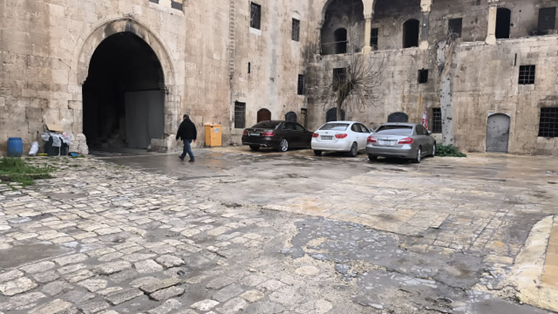
Case No. -008- Restoration of Khan al-Wazir floor with black Asphalt
Monitoring Report:
As part of the Architectural heritage violations observatory's ongoing activities in documenting and protecting Syrian architectural heritage, the field team has monitored a technical violation in "Khan al-Wazir" in the old city of Aleppo. built in 1683 AD, the Khan is considered one of the most significant historical commercial hubs.
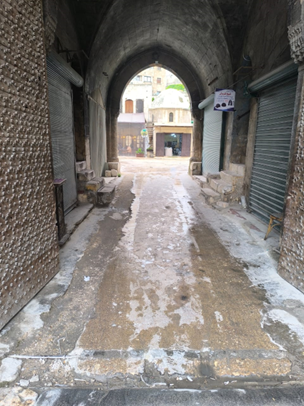
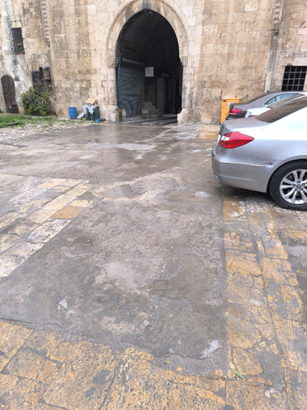
On March 25, 2026, non-systematic restoration works affecting the floor of the Khan's entrance were monitored, and their negative impact on the building's structural and visual authenticity will be clarified.
Description of the Violation:
The replacement of the traditional stone flooring at the Khan's entrance with "Black Zriqa" (Asphalt Squeegee) was observed. This intervention contradicts the standards for preserving archaeological sites. The gravity of this violation is represented in the following:
Constant pressure will be generated on the stones adjacent to the asphalt due to its high thermal expansion coefficient compared to stone, accelerating their deterioration.
Water pooling was noticed due to the absence of calculated slopes in the asphalt layer, turning the Khan’s entrance into a focal point for water collection, which will affect the archaeological walls as rising damp.
The use of black color and asphalt texture creates a visual imbalance within the archaeological stone fabric, affecting the authenticity of the site and its original materials.
Technical Assessment:
The alterations made at this site are considered a violation of architectural heritage for the following reasons:
Violation of the Venice Charter Principles: Through the use of modern, incompatible materials and changing the general character of the site.
Distortion of Aleppo’s Heritage Value: Given that the city of Aleppo is classified as a UNESCO World Heritage site, any unstudied intervention weakens the site's Outstanding Universal Value.
Violation of the Minimum Intervention Principle: Interventions should be "light" and reversible, whereas the asphalt is permanent and may be difficult to remove without causing damage.
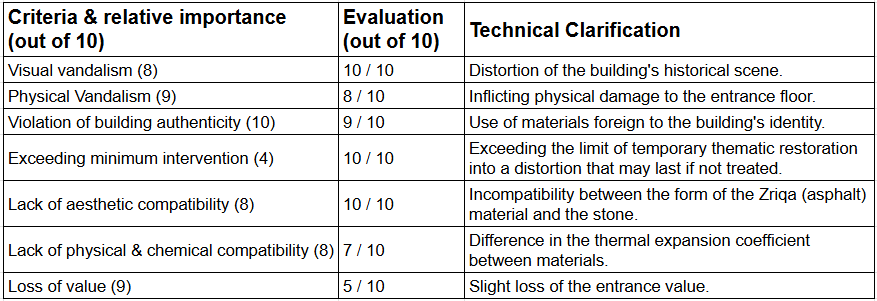
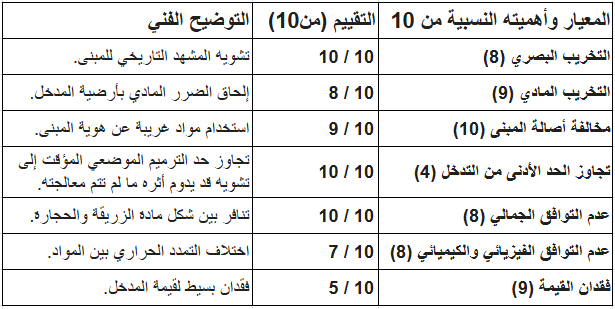
Standardized Evaluation: (As per the attached table image)
Evaluation Result: 6/10 (Moderate risk). The problem is rectifiable, but urgent intervention is required to prevent physical damage to the neighboring stone fabric and visual damage to the building's heritage fabric.
Treatment Recommendations:
Removing the asphalt layer using light manual tools to ensure no damage is caused to adjacent materials.
Using natural limestone similar to the neighboring stones, following a paving method that integrates with the existing pattern.
Implementing precise slopes (1-2%) to direct water away from the stone walls and using traditional lime mortar instead of cement.
Emphasizing the necessity of reviewing any future intervention or restoration by restoration experts from official government bodies or Observatory experts, and ensuring that such violations which may undermine Aleppo's status on the World Heritage List are not repeated.
As part of the Architectural heritage violations observatory's ongoing activities in documenting and protecting Syrian architectural heritage, the field team has monitored a technical violation in "Khan al-Wazir" in the old city of Aleppo. built in 1683 AD, the Khan is considered one of the most significant historical commercial hubs.
On March 25, 2026, non-systematic restoration works affecting the floor of the Khan's entrance were monitored, and their negative impact on the building's structural and visual authenticity will be clarified.
Description of the Violation:
The replacement of the traditional stone flooring at the Khan's entrance with "Black Zriqa" (Asphalt Squeegee) was observed. This intervention contradicts the standards for preserving archaeological sites. The gravity of this violation is represented in the following:
Constant pressure will be generated on the stones adjacent to the asphalt due to its high thermal expansion coefficient compared to stone, accelerating their deterioration.
Water pooling was noticed due to the absence of calculated slopes in the asphalt layer, turning the Khan’s entrance into a focal point for water collection, which will affect the archaeological walls as rising damp.
The use of black color and asphalt texture creates a visual imbalance within the archaeological stone fabric, affecting the authenticity of the site and its original materials.
Technical Assessment:
The alterations made at this site are considered a violation of architectural heritage for the following reasons:
Violation of the Venice Charter Principles: Through the use of modern, incompatible materials and changing the general character of the site.
Distortion of Aleppo’s Heritage Value: Given that the city of Aleppo is classified as a UNESCO World Heritage site, any unstudied intervention weakens the site's Outstanding Universal Value.
Violation of the Minimum Intervention Principle: Interventions should be "light" and reversible, whereas the asphalt is permanent and may be difficult to remove without causing damage.
Standardized Evaluation: (As per the attached table image)
Evaluation Result: 6/10 (Moderate risk). The problem is rectifiable, but urgent intervention is required to prevent physical damage to the neighboring stone fabric and visual damage to the building's heritage fabric.
Treatment Recommendations:
Removing the asphalt layer using light manual tools to ensure no damage is caused to adjacent materials.
Using natural limestone similar to the neighboring stones, following a paving method that integrates with the existing pattern.
Implementing precise slopes (1-2%) to direct water away from the stone walls and using traditional lime mortar instead of cement.
Emphasizing the necessity of reviewing any future intervention or restoration by restoration experts from official government bodies or Observatory experts, and ensuring that such violations which may undermine Aleppo's status on the World Heritage List are not repeated.
Gallery